 Professional DJ Turntable for iPhone
dSL1200
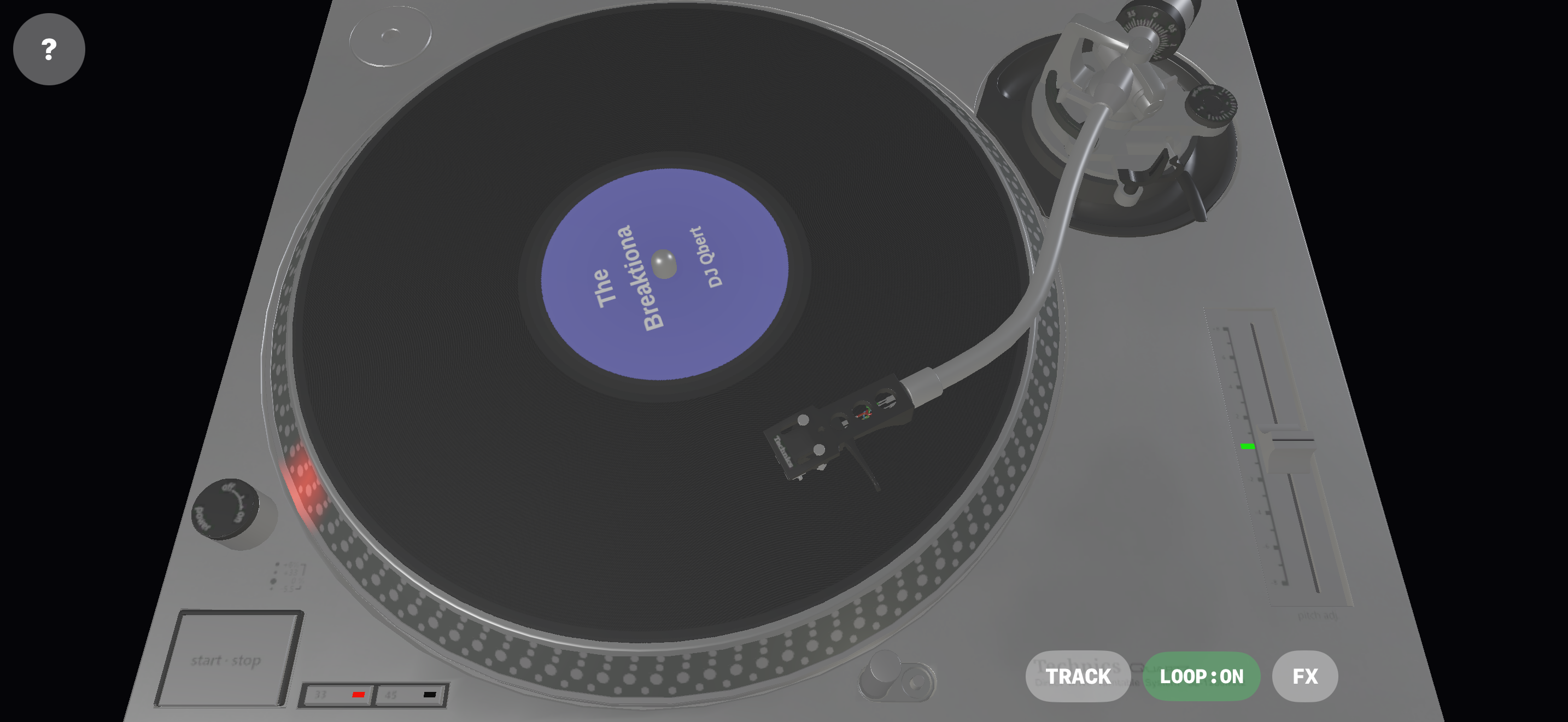
A faithful real-time simulation of the most-used direct-drive turntable in DJ history — every part of the deck modeled in 3D, most touch-controllable.
Professional DJ Turntable for iPhone
A faithful real-time simulation of the most-used direct-drive turntable in DJ history — every part of the deck modeled in 3D, most touch-controllable.
For nearly fifty years, one direct-drive turntable has been the de-facto industry standard in clubs, hip-hop, dance, and bedroom studios across the world. dSL1200 captures that deck — its motor, its slipmat, its quartz-locked strobe, its long-throw pitch fader, its tonearm tracking — as a working real-time simulation, not a skin or a sample player.
Touch the vinyl and the platter responds the way a real one does. The motor keeps spinning underneath while you scratch, the slipmat couples back when you let go, and the audio rate follows your finger through every back-cue, body-tricks rub, and crab. The strobe dots freeze at 33⅓ and 45 RPM, and drift the moment the pitch fader leaves center — the same visual feedback DJs have used to beat-match by eye for half a century.
The full deck — motor, slipmat, scratch physics, strobe — also loads as an Audio Unit Extension inside GarageBand iOS, AUM, Cubasis, BeatMaker 3, Drambo, and Logic Pro for iPad. Drop audio files onto the plugin, scratch with touch or a MIDI pitch-bend wheel, drive the ±8 % pitch from a mod wheel, and route the deck's stereo straight into your DAW's mixer. Read more about the AUv3 plugin →
Every feature is here because the original turntable has it — the motor and slipmat, the pitch fader, the strobe, the tonearm, the lighting, every button and lamp. dSL1200 is a working homage, not an interpretation.
Constant-torque direct-drive motor with a 0.7-second spin-up to 45 RPM, slipmat coupling that keeps the platter running while you grab the vinyl, and a slipmat re-engagement curve tuned to feel like the real coupling on release.
Built on a custom scratch engine designed from the ground up for touch input on glass. Audio rate follows your finger through every back-cue, body-trick rub, and crab — no drift, no missed cues, no audible quantization. Hard releases throw with real inertia; slow releases re-engage the slipmat smoothly.
Cross-product math in the platter's world frame means one degree of finger sweep equals one degree of vinyl rotation, regardless of camera tilt or screen size. One full finger loop = one full record turn = exactly 1.8 seconds at 33⅓.
End-to-end touch-to-audio response under 6 ms. Adaptive high-resolution audio processing keeps fast scratches clean of aliasing without manual settings. The result is the warmth and feel of a real deck, with zero of the noise, hum, or wow-and-flutter of physical hardware.
Faithful to the original long-throw pitch fader range, with a center detent that snaps to nominal on a double-tap. The pitch fader shifts the strobe drift independently of the motor, so you can beat-match by eye exactly the way the deck was designed for.
The multi-dot rim ring locks at exactly 33⅓ and 45 RPM through honest motor-rate-driven strobe physics. Pitch off center and the dots drift; lock to nominal and they freeze. Multiple dot patterns and motion-blur modes available.
Pick any DRM-free track from your synced Music library. The vinyl label is generated dynamically from each track's metadata — title and artist printed on the LP every time you load a song — so the deck always shows you what's playing. Library entries take priority, with embedded ID3 tags and a smart filename parser as automatic fallbacks.
Toggle loop mode and the track wraps with zero-sample-gap continuity — perfect for chopping b-boy breaks, drum loops, and battle samples for hours without a beat dropped. Cue points and back-cues across the loop boundary work transparently. Built on a ring-buffered streaming engine that handles tracks of any length without loading the whole file into memory.
Load any installed Audio Unit Extension effect plugin into a wet/dry parallel mix. Reverb, delay, filters, EQ, distortion — any AUv3 plugin you have on the device works. Per-slot bypass and a global wet/dry blend give you a real DJ-style master FX path.
Drag the arm to cue and tap the cue lever to lift and drop — the arm sweeps from outer rim to inner spindle in real time with the audio playhead. The anti-skating dial, height adjustment, and counterweight are modeled on the 3D deck for visual fidelity to the original, though not user-adjustable in this version. Cue-up by ear or by eye.
The pop-up inspection lamp lifts and lights with a warm bulb when toggled, just like the original. More dramatically, a red strobe LED throws a sharp glowing arc across the platter rim — the same flashing red light that makes a working deck look alive in low-light club environments.
Native 120 Hz on ProMotion devices, 60 Hz everywhere else, with PBR lighting, real-time reflections, vinyl groove geometry, and adaptive touch-density compensation so scratching feels identical regardless of refresh rate.
The differences between a DJ app and a working deck live in the parts most people don't notice — until they're missing.
iPhone digitizers sample touches at 120 Hz internally regardless of display refresh. dSL1200 processes every coalesced sample, so a 60 Hz iPhone gets the same scratch resolution as a 120 Hz one.
Two independent rotating bodies — the motor-driven platter and the vinyl resting on the slipmat — coupled through a friction model. Grab the vinyl, the platter keeps turning underneath. Let go, the vinyl re-couples to the platter rate over a tuned ramp. The audio rate follows the vinyl, not the motor.
Tracks under fifteen minutes load fully in memory; longer tracks stream into a ring buffer with seek + back-cue support. You can scratch a 90-minute live recording the same way you scratch a 7" single.
The high-resolution resampler automatically widens its anti-alias filter as your scratch speed rises, so back-cues and fast crabs stay clean instead of folding into harsh aliasing artifacts.
The scratch controller recomputes the playback rate every 16 ms; dSL1200 then smoothly interpolates that rate across each audio buffer instead of stair-stepping. The difference is the difference between a working deck and a glitchy emulator.
Apple Music synced files often have empty ID3 tags but rich library metadata. dSL1200 prefers the library's organized title/artist when available, falls back to embedded asset tags, and finally parses the filename — so the LP label always reads the way the user expects.